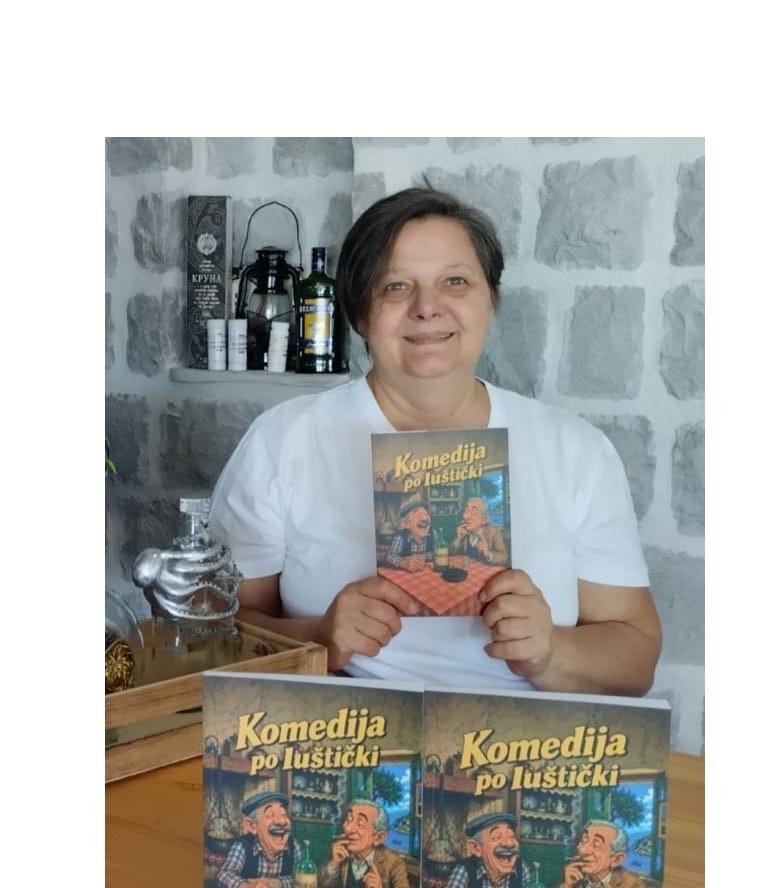
Almost a month after its launch in Tivat, the book has lost none of its topicality, and readers' interest confirms that stories about a particular mentality transcend the boundaries of the place they come from.
The book contains twenty stories based on real events and people, whose identities, with certain changes, have been preserved in literary form.
Behind seemingly everyday anecdotes lies a testimony to people whose ancestors sailed the seas of the world and brought back different cultural influences, while preserving their own speech, customs and particular outlook on life.
As the author explains on the new edition of Radio Kotor's “Sunday Conversation”, the stories first came out of a personal need to record events she found funny, unusual and worth remembering. She began writing them down in the 1990s, in a time of war, finding refuge in them.
“At first I wrote the stories down for myself, because they made me happy. Whenever I heard some bad news on television, it meant a lot to me to step back, return to those stories and have a good laugh,” our interviewee recalls.
Later she wanted to preserve the stories for her children too, so that they could learn about the way of life of previous generations and the values that once bound the whole community together.
Family, friendship and neighbourly solidarity hold a special place in that heritage.
“In the past the family was much wider. It included godparents and uncles on both the mother's and the father's side, and they were regarded as immediate family. That is slowly being lost. Somehow people are increasingly turned in on themselves or on the person closest to them, and that saddens me,” said Mrkovčević.
Her stories were most often born spontaneously, over coffee, during breaks in the olive groves or when people met at the field boundaries. Old and young would gather there, retelling events, filling in each other's stories and keeping memories alive.
It is precisely such get-togethers, she believes, that are one of the values the fast pace of modern life is increasingly pushing aside.
She added that she had also tried to start a small crochet and knitting school for young people on Luštica, to pass on her knowledge and skills to others, but unfortunately there was not enough interest.
The conversation also took us to the Luštica dialect and its local words, which are slowly disappearing from everyday use. She tries to preserve them and pass them on to new generations, because language is an important part of a region's identity.
A special part of the conversation, particularly interesting with the holidays approaching, was devoted to traditional Luštica cuisine and Christmas and Easter customs.
The author recalled dishes that were once a must on family tables, some of which are no longer served.
“They include zelje i fažola, that is, boiled raštan and white beans seasoned with salt and olive oil, as well as a savoury soup made from boiled bones, with macaroni, after which boiled prosciutto with potatoes was served. There is also kaštradina (dried mutton) with greens, bacon and homemade flour sausages, which took special skill to prepare,” she explains.
For the Christmas table, she adds, špaleta was traditionally prepared, that is, a shoulder joint smoked for around fifteen days, then boiled and served with potatoes.
“Soup was a must at every meal, while priganice (fritters), sponge cake and Christmas bread were an essential part of the festive menu. On Christmas Eve, salt cod was prepared, usually as a stew, while at Easter the table was completed by roast meat, painted eggs and, once again, priganice. They were served with dried figs, raisins and the indispensable maginjača (strawberry-tree brandy),” says Mrkovčević.
Equally interesting were her recollections of the traditional attitude towards the olive.
In the past, green olives were not picked from the branches for oil; instead, she notes, people waited for the fruit to fall by itself once it had reached the right ripeness.
“The olive groves were carefully cleared, and the gatherings at harvest time were an opportunity to talk, socialise and swap stories. My father-in-law never allowed us to cut a branch off an olive tree. He always said that when the fruit is full of oil, it will fall by itself. And while it is green and on the branch, that means: don't touch me,” our guest recounted, passing on the experience and beliefs of older generations.
Although she has many more stories written down, for now she is staying true to real events and people. She believes that they alone hold enough material to preserve what time inexorably changes.
The message with which she rounded off her collection, and our conversation today, is: “As long as the stories are told, Luštica lives on.”
You can listen to the conversation at the link Sunday Conversation.