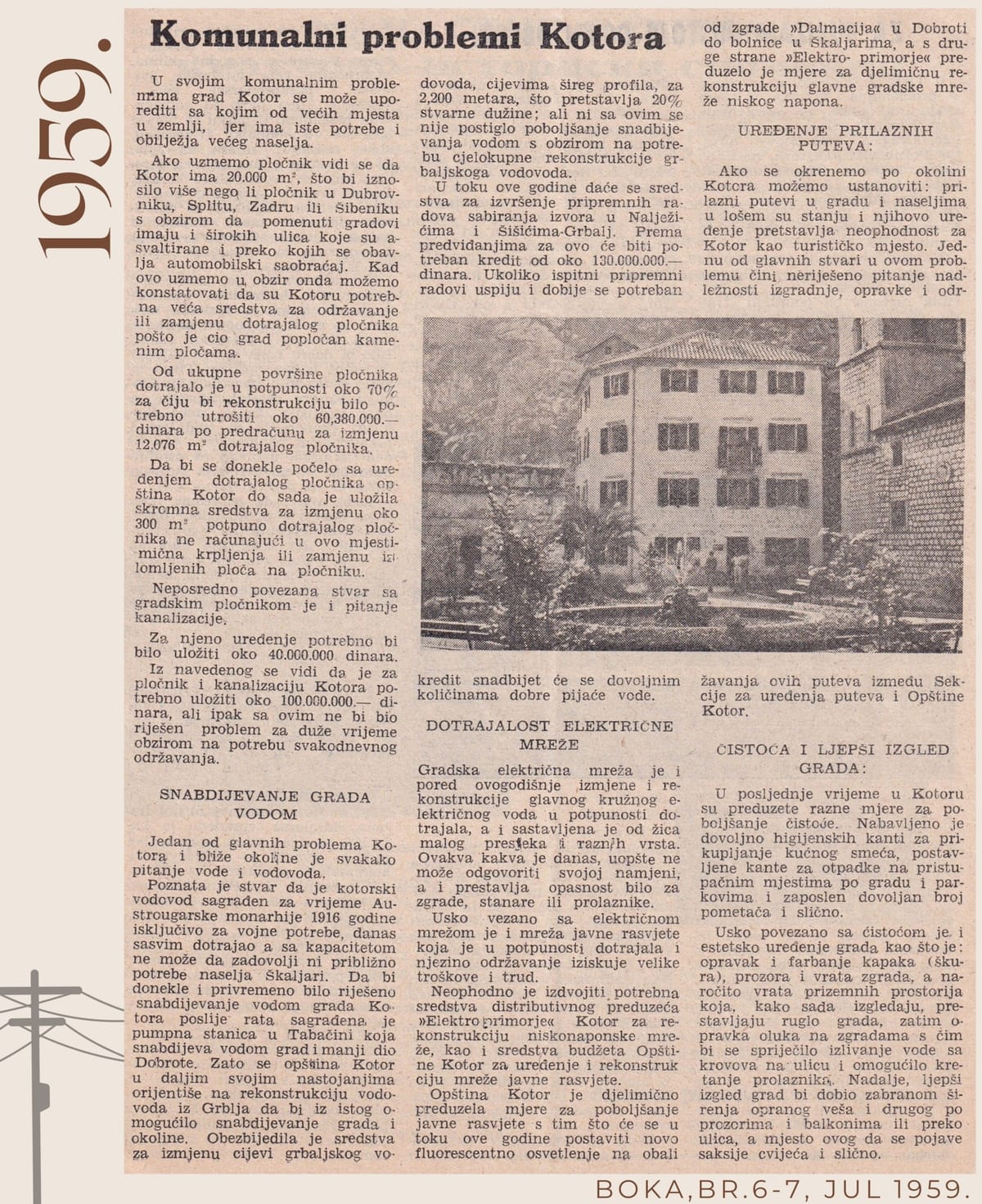
If we take the paving, we find that Kotor has 20,000 m2 of it, which would amount to more than the paving in Dubrovnik, Split, Zadar or Šibenik, given that those towns also have wide asphalted streets that carry motor traffic. Taking this into account, we can state that Kotor needs greater funds for maintaining or replacing its worn-out paving, since the whole town is paved with stone slabs.
Of the total area of paving, some 70% is completely worn out, and its reconstruction would require spending about 60,380,000 dinars, according to the estimate for replacing 12,076 m2 of worn-out paving.
To make at least a start on repairing the worn-out paving, Kotor Municipality has so far invested modest funds in replacing about 300 m2 of completely worn-out paving, not counting the patching here and there or the replacement of broken paving slabs.
Directly connected with the town's paving is the question of the sewers.
Putting them in order would require an investment of about 40,000,000 dinars.
From the above it can be seen that about 100,000,000 dinars needs to be invested in Kotor's paving and sewers, and yet even this would not solve the problem for long, given the need for daily maintenance.
THE TOWN'S WATER SUPPLY
One of the main problems of Kotor and its immediate surroundings is certainly the question of water and the water supply system.
It is well known that the Kotor water supply system was built under the Austro-Hungarian monarchy in 1916 exclusively for military needs; today it is completely worn out, and its capacity cannot come anywhere near meeting the needs of the settlement of Škaljari. To provide at least a partial and temporary solution to Kotor's water supply, a pumping station was built at Tabačina after the war, which supplies water to the town and a small part of Dobrota. Kotor Municipality is therefore directing its further efforts towards reconstructing the water supply system from Grbalj, so that the town and its surroundings can be supplied from it. It has secured funds to replace the pipes of the Grbalj water supply system with wider-bore pipes over 2,200 metres, which represents 20% of its actual length; but even this has not improved the water supply, given the need for a complete reconstruction of the Grbalj system.
In the course of this year funds will be provided for the preparatory work of capturing the springs at Nalježići and Šišići-Grbalj. According to the estimates, this will require a loan of about 130,000,000 dinars. If the exploratory preparatory works succeed and the necessary loan is obtained, sufficient quantities of good drinking water will be supplied.
THE WORN-OUT ELECTRICITY NETWORK
Despite this year's replacement and reconstruction of the main ring line, the town's electricity network is completely worn out, and it is also made up of wires of small cross-section and of various kinds.
As it is today, it cannot serve its purpose at all, and it is also a danger to buildings, residents and passers-by alike.
Closely bound up with the electricity network is the street lighting network, which is completely worn out, and its maintenance calls for great expense and effort.
It is essential to set aside the necessary funds of the distribution company “Elektro primorje” Kotor for the reconstruction of the low-voltage network, as well as funds from the budget of Kotor Municipality for the repair and reconstruction of the street lighting network.
Kotor Municipality has taken some measures to improve the street lighting, in that new fluorescent lighting will be installed this year along the waterfront from the “Dalmacija” building in Dobrota to the hospital in Škaljari, while “Elektro primorje” has for its part taken measures for a partial reconstruction of the town's main low-voltage network.
IMPROVING THE ACCESS ROADS:
If we look around the surroundings of Kotor, we can establish that the access roads in the town and the settlements are in a poor state, and putting them right is a necessity for Kotor as a tourist resort. One of the main elements of this problem is the unresolved question of who is responsible for building, repairing and maintaining these roads, the Road Maintenance Section or Kotor Municipality.
CLEANLINESS AND A MORE ATTRACTIVE TOWN:
Recently various measures have been taken in Kotor to improve cleanliness. Enough sanitary dustbins have been acquired for collecting household rubbish, litter bins have been put up at accessible points around the town and in the parks, a sufficient number of street sweepers have been taken on, and so forth.
Closely connected with cleanliness is the aesthetic improvement of the town, such as: repairing and painting the shutters (škure), windows and doors of buildings, and especially the doors of ground-floor premises, which, as they look now, are an eyesore for the town; then repairing the gutters on buildings, which would stop water pouring off the roofs into the street and allow passers-by to move about. Furthermore, the town would look more attractive if hanging out washing and other things from windows and balconies or across the streets were banned, and flowerpots and the like appeared in their place.