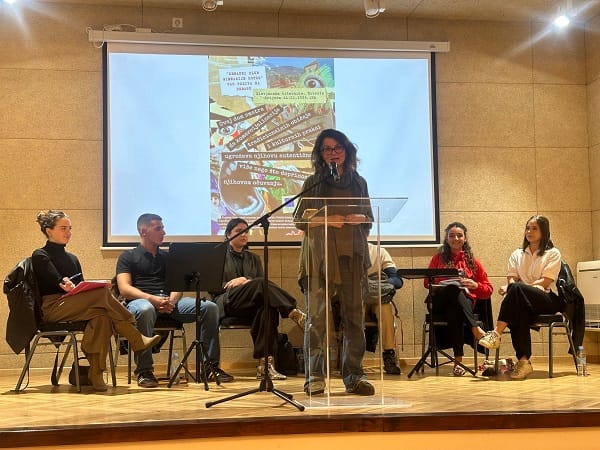
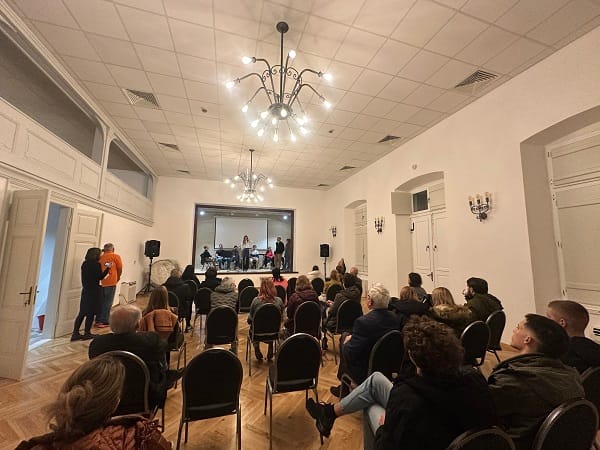
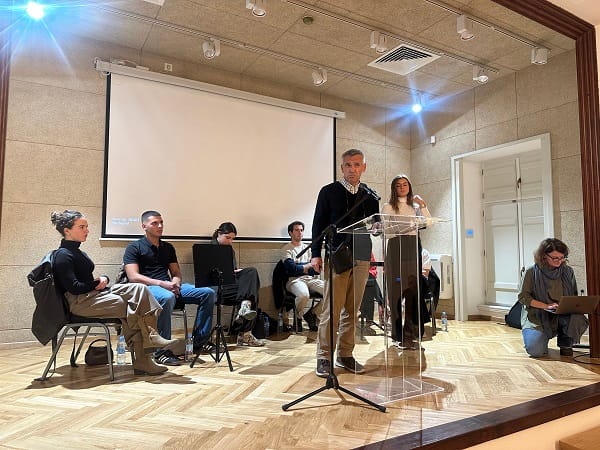
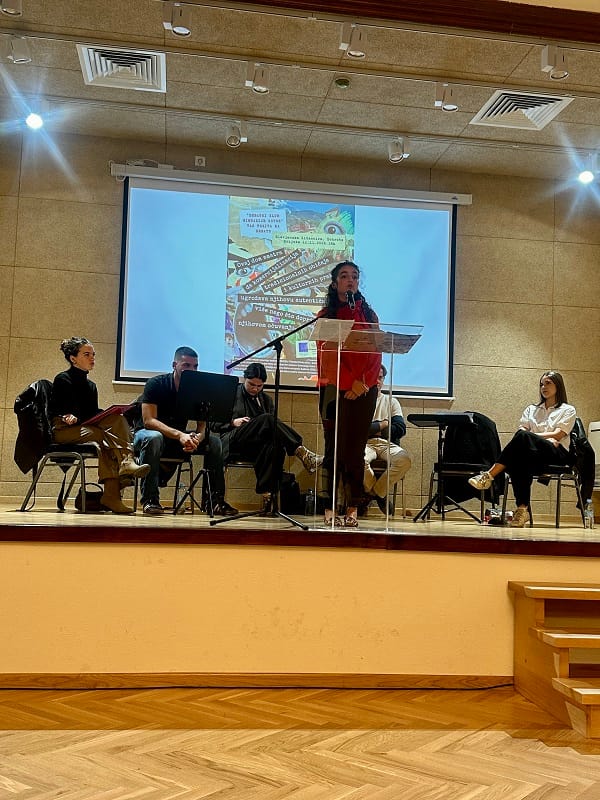
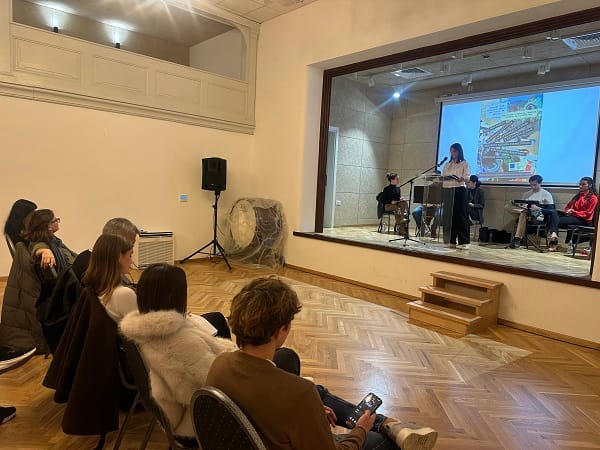
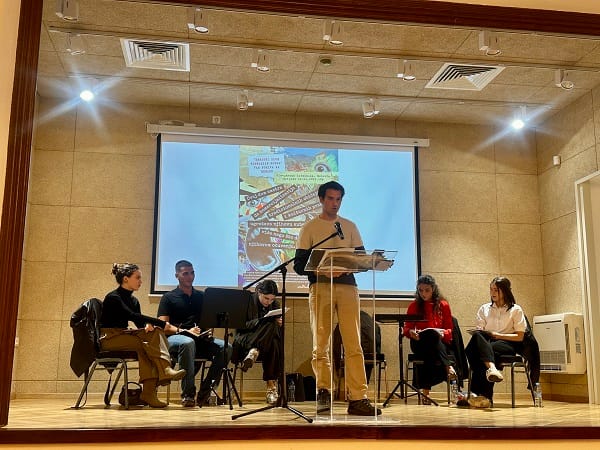
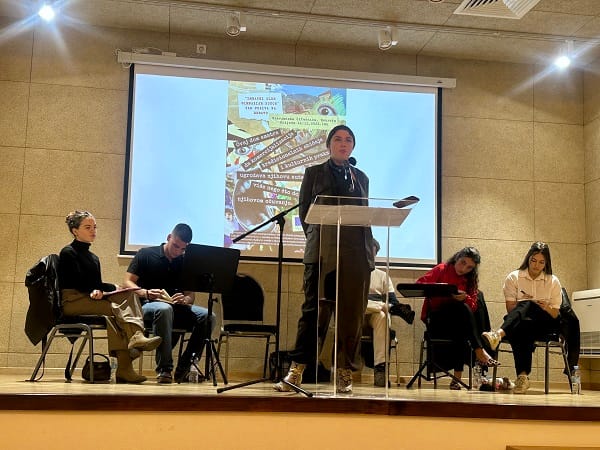
Mixed debating teams of second-, third- and fourth-year students from Kotor Gymnasium argued the motion, and the debate was chaired by Paula Petričević, a philosophy teacher at the school.
The debate was organised as part of the project “How Young People Understand Heritage: Between the Traditional and the Contemporary”, run by Expedition Architects d.o.o. in cooperation with the Kotor Gymnasium Debate Club, with the support of the Ministry of Culture and Media, as part of European Heritage Days 2026.
At the start, the teacher Paula Petričević welcomed those present and invited them, after the debate, to vote via the QR code on display for the team they felt had defended its case better.
“I would also like to thank Expedition for managing, as part of this project, to provide through the company Faksimil this beautiful lectern, which will stay at the Slavic Reading Room as a gift from the Kotor Gymnasium Debate Club for all future events held in this lovely space. Thank you all for showing an interest and for coming. I welcome you and invite you to vote, and of course vote on the arguments, not on which team you like more or which side you personally lean towards,” she said, among other things.
The affirmative team, made up of Lana Janović as first affirmative speaker, Anđela Popović and Drago Rapovac, firmly defended the argument that it is precisely commercialisation that limits the authenticity of all traditional customs and cultural assets.
In support of their case, Janović set out definitions of the key terms.
Commercialisation - the process of transforming cultural assets, symbols and customs into ordinary goods, mass consumer goods. Its primary purpose is to make a financial profit on the market, so that intrinsic value and symbolic significance are replaced by economic profitability.
Traditional customs and cultural practices - they are the authentic form of a people's or a community's heritage, passed down through generations through symbolism, ritual function and deep inner meaning, serving to preserve collective identity rather than as entertainment for outside observers.
Authenticity - the original, untouched integrity of a tradition, resting on its original context.
“The criterion we stand for with our case is the integrity of cultural heritage. It is not just decoration on paper, but a measurable professional standard that obliges us to ensure that every intervention in a space, whether conservation or landscaping, goes through strict protection measures. This criterion serves precisely to stop short-term interests from destroying what history has entrusted to us. Our line of argument consists of two arguments. We called the first argument the erosion of authentic cultural meaning. This argument explains the internal mechanism of the damage, what happens to a custom the moment it becomes a commodity. Traditional customs did not come about as an aesthetic spectacle for tourists. They came about as a deep expression of a community's identity, faith, togetherness or historical memory,” Janović said, among other things.
Asked by the opposing team, she said she did not think that only what is untouched is authentic.
“We are not here to defend something that will never change, nor are we saying that evolution does not add to its significance. But for us, authenticity means that the source of the tradition is not lost. The fact that this authenticity may change a little over time or adapt to the times does not mean that its very source, or the purpose of the whole tradition or custom, is lost,” she said.
On the other side, the negative team, or opposition, was made up of Andrea Rapovac, Damjan Pajović and Marta Borović.
“The motion of today's debate is: this house believes that the commercialisation of cultural practices threatens their authenticity more than it contributes to their preservation. First, I will set out our definitions. Commercialisation: a sustainable mechanism for funding tradition and integrating it into the modern economy, providing the income communities need to survive. Without profit and an economic motive, people would not have the means to devote themselves to preserving tradition. Commercialisation is a lifeline, not a threat. Traditional custom: a living, dynamic and adaptable category of inherited behaviour, not rigid museum exhibits. It is precisely through openness to the market and to audiences that tradition proves its vitality; only what lives in the present survives. Cultural practices: a community's ways of expressing itself and acting, passed down from generation to generation, whose sustainability is best measured by how actively they are used and practised. Commercialisation offers a platform for cultural practices to be seen by a wider public, which encourages young people to keep practising them. The affirmative claims that economic valorisation supposedly destroys the core of a custom; the negative shows that commercialisation does not threaten tradition but protects it from its only real enemy, oblivion,” said Andrea Rapovac, the negative team's first speaker, among other things. Like Lana Janović, she was debating for the first time, and both were mentored by older fellow debaters.
The debate was judged by the sociology teacher Mladen Živković and the experienced debater Ena Božović, with the third vote going to the audience, who used the QR code to vote for the team that seemed to have defended its position more convincingly.
“It is up to the affirmative to define the terms, so if the negative did not knock down those terms, then it is problematic to define commercialisation differently from the way the affirmative did. Then, as for the supporting arguments themselves, we can say that the negative was more vivid, but with certain questions and certain explanations the affirmative managed to knock down that support, for example in the part about what will happen to traditions that do not make a profit, which simply will not survive thanks to money, so in that sense your argument was knocked down. All in all, a truly first-rate debate,” said Živković.
Ena Božović gave her vote to the affirmative team.
“For the following reasons, above all the criteria of both teams. As someone who has been debating for a long time, I found the criteria of both teams unclear, but I think the affirmative somehow did more to refute the negative's criterion than the negative did even to address the affirmative's criterion, which I think is very important in a debate. Whoever refutes the criterion is automatically the winner,” she said.
At the end, the audience had the chance to write down suggestions for topics for the next public debate that they would like to hear Kotor Gymnasium's debaters discuss.